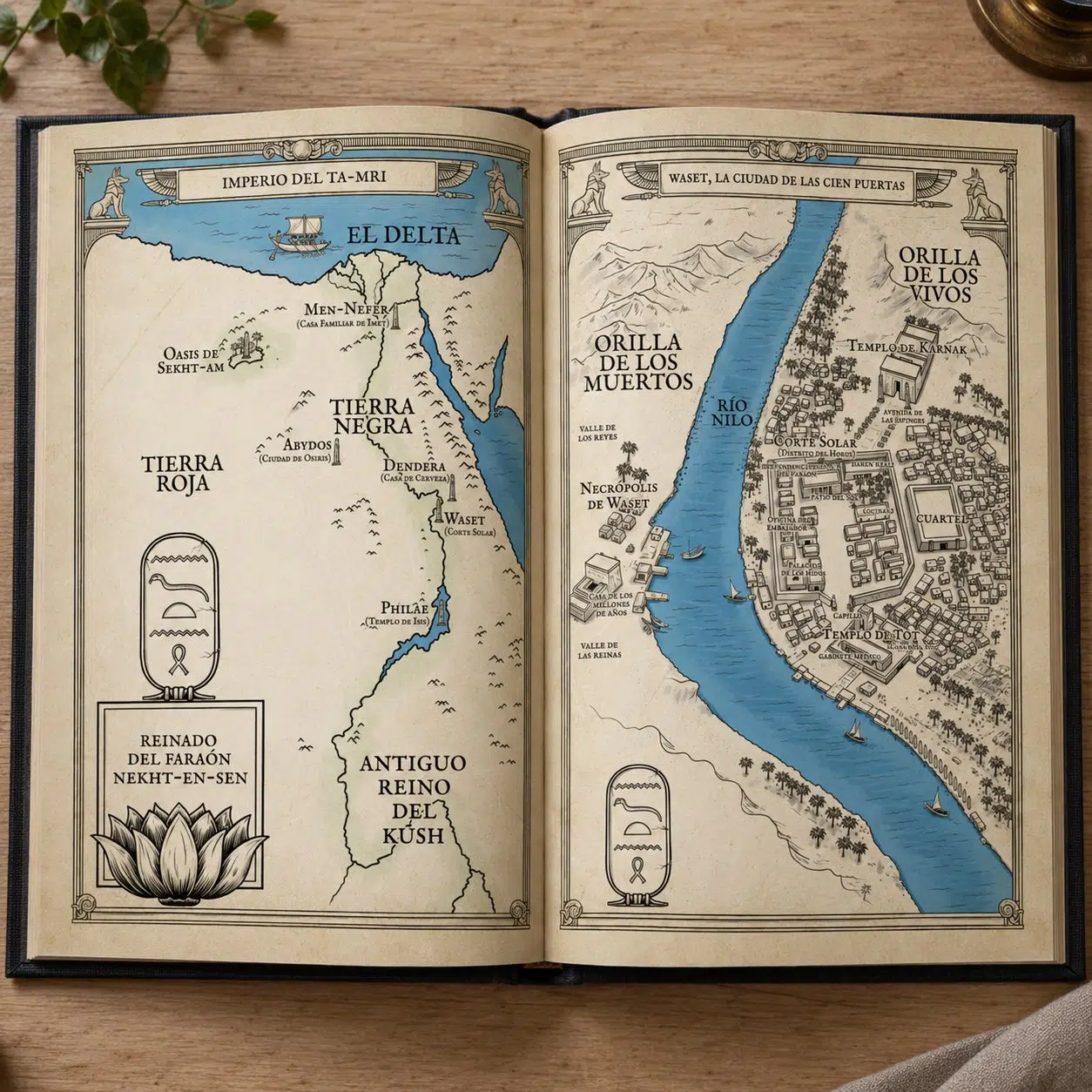
Maps in books and novels help readers picture an invented world and follow the plot. If you are about to hire a map illustrator, this guide explains the types of maps you can commission, the most common techniques and what to prepare so the project runs smoothly.
Note: this is an informative guide. If you want to commission an illustrated map for your novel, you can see examples of my work and how we collaborate on my map illustration page.
Hire a map illustrator

Why hire a map illustrator for your book?
A good map is much more than decoration. It shows the scale of the world, the distances the characters travel and the relationships between kingdoms, cities and seas. In fantasy, science fiction, historical fiction or adventure, it becomes part of the worldbuilding and an invitation to start reading. A professional illustrator turns your notes or sketch into a clear, attractive image that also meets the technical needs of printing.
Types of illustrated maps for books
Before you contact an illustrator, think about which kind of map your story needs:
- World maps: the whole invented world, with continents, seas, rivers, mountain ranges and main cities.
- Regional maps: a specific area of the world, such as a kingdom, an archipelago or a mountain region, with more detail.
- City maps: streets, districts and landmarks of a single city, ideal for urban fantasy or mystery.
- Buildings and fortresses: floor plans of castles, ships, palaces or battlefields where key scenes happen.
- Historical maps: real places and periods, like the War and Peace map of Europe in 1812.

Map illustration techniques
Each technique gives a different feel, so it is worth knowing the options:
- Hand drawing: pencil or ink on paper. It brings texture and a classic, antique look.
- Digital illustration: created with tools such as Photoshop, Illustrator, Procreate or Krita. It offers precision and makes later corrections much easier.
- Watercolour or colour styles: softer and more artistic, perfect for children’s books or special editions.
- Black and white line work: the most common choice for novel interiors, because it prints sharply on any paper.
Many professional maps combine techniques: a pencil sketch for the composition, digital inking for clean lines and textures added at the end.
What to prepare before you hire a map illustrator
The more information you share, the closer the first draft will be to what you imagine. Have these ready:
- A rough sketch of your world, even a very simple one. It does not need to be pretty, only accurate.
- A list of the places that must appear, ranked by importance.
- The genre, tone and target audience of the book.
- Two or three maps you like as visual references.
- The trim size of the book and whether the map will be a single page or a double spread.
- Your publication date, so the schedule fits.
How the process usually works
- Briefing: you send the sketch, the list of places and your references.
- Layout sketch: the illustrator organises the territories, labels and decorative elements.
- Revisions: you check that geography and names match the story.
- Final art: inking, textures, lettering and a print-ready file at the right size and resolution.

How to choose the right map illustrator
Look at the portfolio and check that it includes maps similar to the style you want. Ask whether the illustrator has worked with publishers and understands print requirements, how many revision rounds are included and who handles the lettering. Clear communication matters as much as talent: the map has to respect the internal logic of your world.
You can find more ideas in what an illustrated map is and why the best books have one, or see a complete example in the Monarchies of God map.
Ready to hire a map illustrator for your novel, a cover or a children’s book? Get in touch and tell me about your project.